

Two NASA spacecraft on Mars – one on the surface, the other in orbit – have recorded the largest meteor impacts and impact craters ever.
Last year, high-velocity dams sent seismic waves rippling thousands of miles across Mars, forming craters about 500 feet (150 meters) in diameter, first detected near the surface of another planet, scientists reported Thursday in Science.
The larger of the two strikes churned up rock-sized ice sheets, which could help researchers look for ways future astronauts can exploit Mars’ natural resources.
While the InSight spacecraft measured seismic shocks, the Mars Rover provided stunning pictures of the exposed craters.
Liliya Posiolova of Malin Space Science Systems in San Diego and co-author of the study, Liliya Posiolova, said viewing the craters “would be huge anyway”, but mapping it to seismic surges is a bonus. “We were very lucky.”

Mars’ atmosphere is thin, unlike Earth’s, where the thick atmosphere prevents most space rocks from reaching the ground, instead breaking and burning them.
A separate study last month correlated a recent series of smaller Martian meteoroid collisions with smaller craters closer to InSight, using data from the same lander and orbiter.
The impact observations came as InSight neared the end of its mission, as its dwindling power and solar panels were covered in dust storms. InSight landed on Mars’ equatorial plains in 2018 and has since recorded more than 1,300 marsquakes.
“It will be very upsetting when we finally lose contact with InSight,” said Bruce Banerdt, the lander’s lead scientist at NASA’s Jet Propulsion Laboratory, who was involved in the studies. “But the data he sends us will certainly keep us busy for years to come.”
Banerdt estimated that the lander had another four to eight weeks to run out of power.
The incoming space rocks are between 16 feet and 40 feet (5 meters and 12 meters) in diameter, Posiolova said. The effects were recorded at a magnitude of 4.
The larger of the two struck about 2,200 miles (3,500 km) from InSight last December, creating a crater about 21 feet deep. Posiolova said the orbiter’s cameras showed the debris thrown up to 40km from the impact, as well as the chunks of white ice around the crater, were the most frozen water ever observed at such low latitudes.
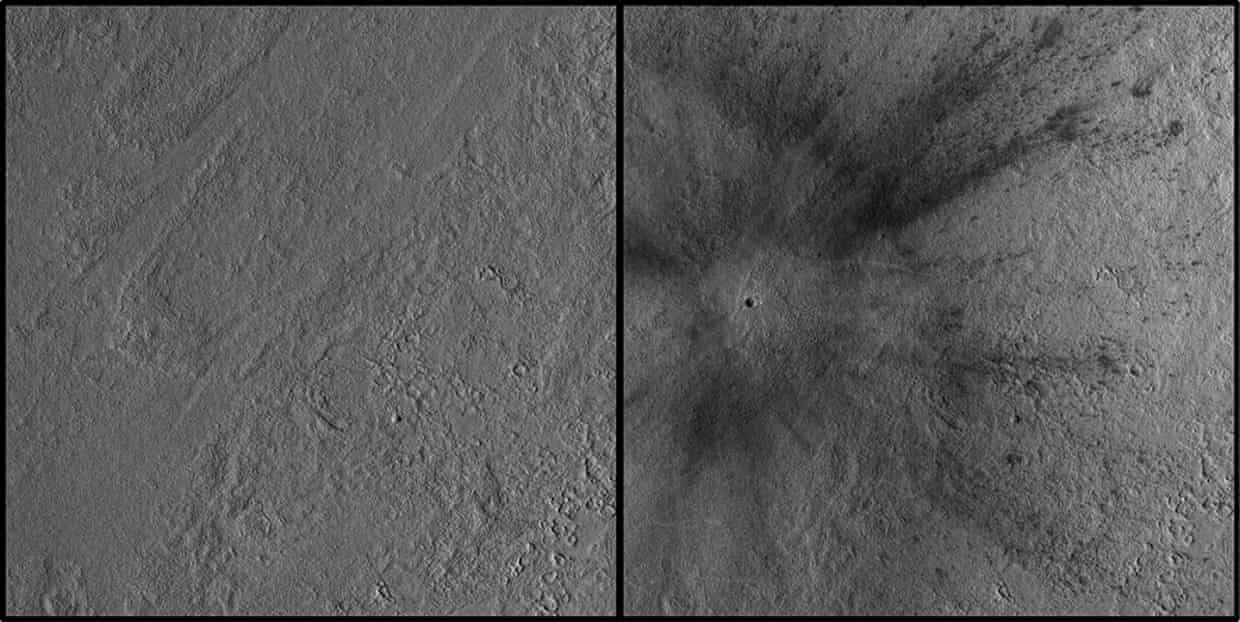
Posiolova spotted the crater earlier this year after taking extra pictures of the area from orbit. The crater was absent from previous photographs and, after perusing the archives, pinpointed the impact towards the end of December. He recalled a major seismic event recorded by InSight at the time, and with the help of this team mapped the fresh hole to an unsuspecting meteoroid impact. The blast wave was clearly visible.
Seismic readings from the two collisions point to denser Martian crust beyond InSight’s location.
“We still have a long way to go to understand Mars’ internal structure and dynamics, which are largely enigmatic,” said Doyeon Kim of ETH Zurich’s Geophysics Institute in Switzerland, who was part of the research.
Outside scientists said landers from Europe and China would carry even more advanced seismometers. Yingjie Yang and Xiaofei Chen, of China’s Southern University of Science and Technology in Shenzhen, wrote in an accompanying editorial that future missions will “paint a clearer picture” of how Mars has evolved.
Aucun commentaire
Enregistrer un commentaire