
Now that we have a powerful lens for the deepest parts of the universe, our definition of “surprise” has changed a bit when it comes to astronomical pictures.
It’s no surprise that NASA’s James Webb Space Telescope has revealed another bright, ancient piece of the cosmos. At this point, we know that we should expect no less from us. groundbreaking machine.
Instead, it now feels more like a “JWST hits again” when the telescope sends back a jaw-dropping image of space. And yet, our jaws drop legally every time.
This kind of mismatched version of “Surprise” has happened once again — quite extreme. Last week, scientists presented JWST’s bright image of a galaxy cluster merging around a massive black hole housing a rare quasar, an incomprehensibly bright jet of light emanating from the chaotic center of space.
There’s a lot going on here, I know. But the team behind the finding thinks the situation could escalate further.
“We think something dramatic is going to happen in these systems,” said Andrey Vayner, a Johns Hopkins astronomer and co-author of a study about this scene soon to be published in the Astrophysical Journal Letters. For now, you can review a detailed outline of the discovery in a paper published on arXiv.

An artist’s concept of a galaxy with a bright quasar at its center.
NASA, ESA and J. Olmsted (STScI)
What is particularly fascinating about this portrait is that the quasar in the hand is considered an “extremely red” quasar, meaning it is very far from us and therefore rooted in a region of primitive space physically close to the beginning of time.
In essence, because it takes time Every stream of cosmic light that reaches our eyes and machines for light to travel through space is seen as it was a long time ago. Even moonlight takes about 1.3 seconds to reach Earth, so when we look at the moon, we see it was 1.3 seconds in the past.
More specifically, with this quasar, scientists believe it took about 11.5 billion years for the object’s light to reach Earth, meaning we see it as it was 11.5 billion years ago. This also makes it one of the most powerful of its kind observed from such a huge distance (i.e. 11.5 billion light-years away), according to the team.
“The galaxy, in this perfect moment of its life, is about to transform and look completely different in a few billion years,” Vayner said of the realm where the quasar is anchored.
Analyzing a galactic rarity
We look at a few things in the color image provided by Vayner and other researchers.
Each color in this image represents material moving at a different speed.
ESA/Webb, NASA and CSA, D. Wylezalek, A. Vayner and Q3D Team, N. Zakamska
On the left is the Hubble Space Telescope image of the region studied by the team, and in the middle is an inflated version of the JWST zeroing point. Take a look at the far right of this image with four individual color-coded boxes and you’ll analyze different aspects of the JWST data broken down by speed.
For example, the red thing is moving away from us and the blue is moving towards us.
This classification shows us how each of the galaxies involved in the magnificent merger behaved – including its extreme black hole and accompanying red quasar, in fact the only galaxy that the team expects to uncover with billions of dollars from NASA. instrument.
“What you see here is just a small subset of what’s in the dataset,” said Nadia L. Zakamska, a Johns Hopkins astrophysicist and co-author of the study. “There’s so much going on here, so we first highlighted what’s really the biggest surprise. Every blob here is a baby galaxy merging with this mother galaxy, and the colors are different speeds, and everything moves in an extremely complex way.”
Now, Zakamska says, the team will begin to decode the motions and further improve our view. We’re already looking at much more incredible information than the team expected to begin with. The Hubble and Gemini-North telescope have shown the possibility of a transit galaxy before, but they certainly didn’t hint at the swarm we can see with JWST’s wonderful infrared equipment.
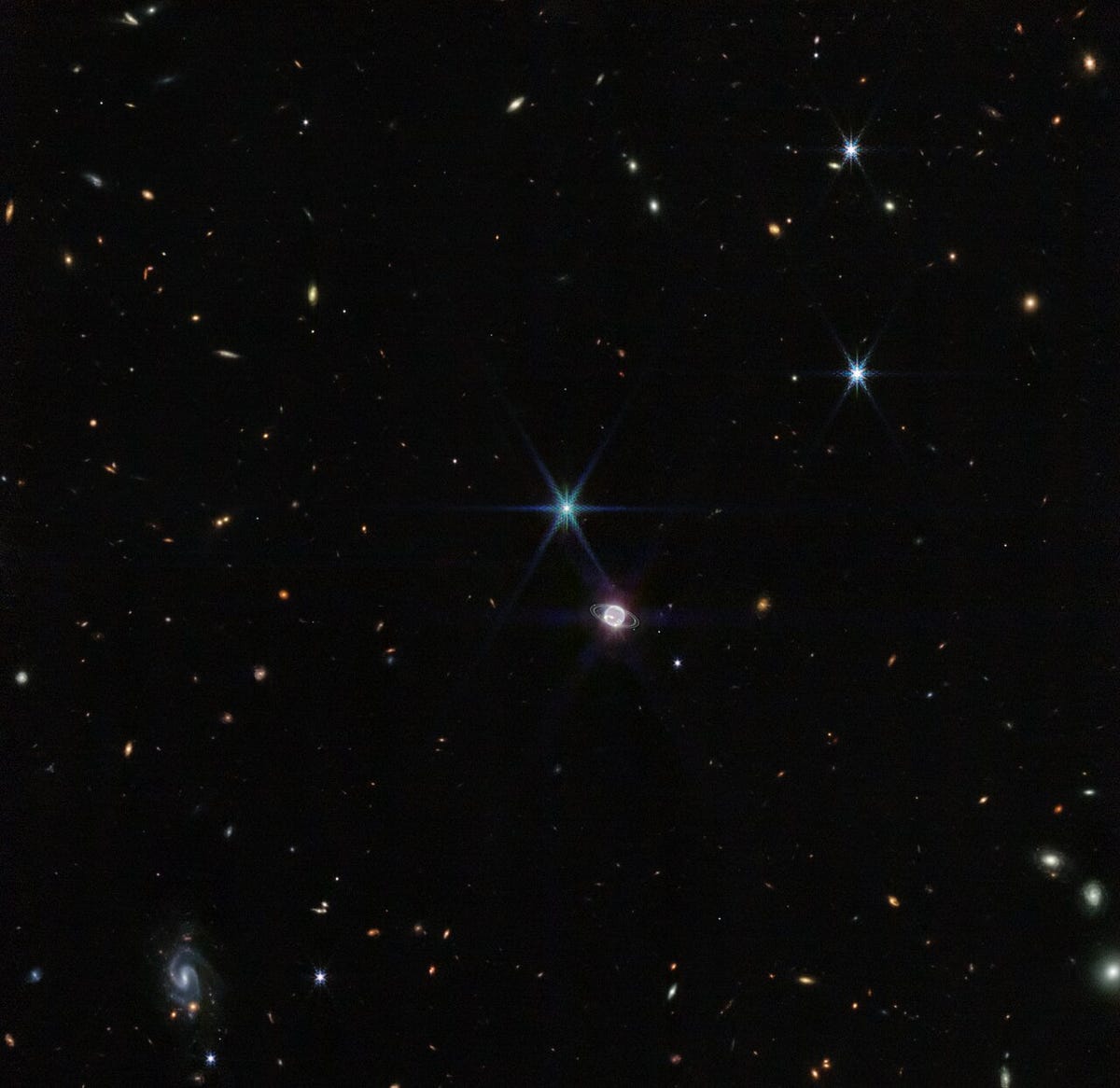
Another spectacular image taken by Webb’s Near Infrared Camera (NIRCam) shows a scattering of hundreds of background galaxies, varying in size and shape, next to the Neptune system.
ESA
“We thought we were seeing hints in previous images that the galaxy was interacting with other galaxies in the merging path, because they were distorted in the process,” Zakamska said. Said. “But after Webb got the data, I was like, ‘I have no idea what we’re looking at here, what is all this stuff?’ I said. We spent a few weeks just looking at these images.”
The team soon said that JWST showed us at least three separate galaxies that were moving incredibly fast. They even believe it could mark one of the densest areas of galaxy formation known in the early universe.
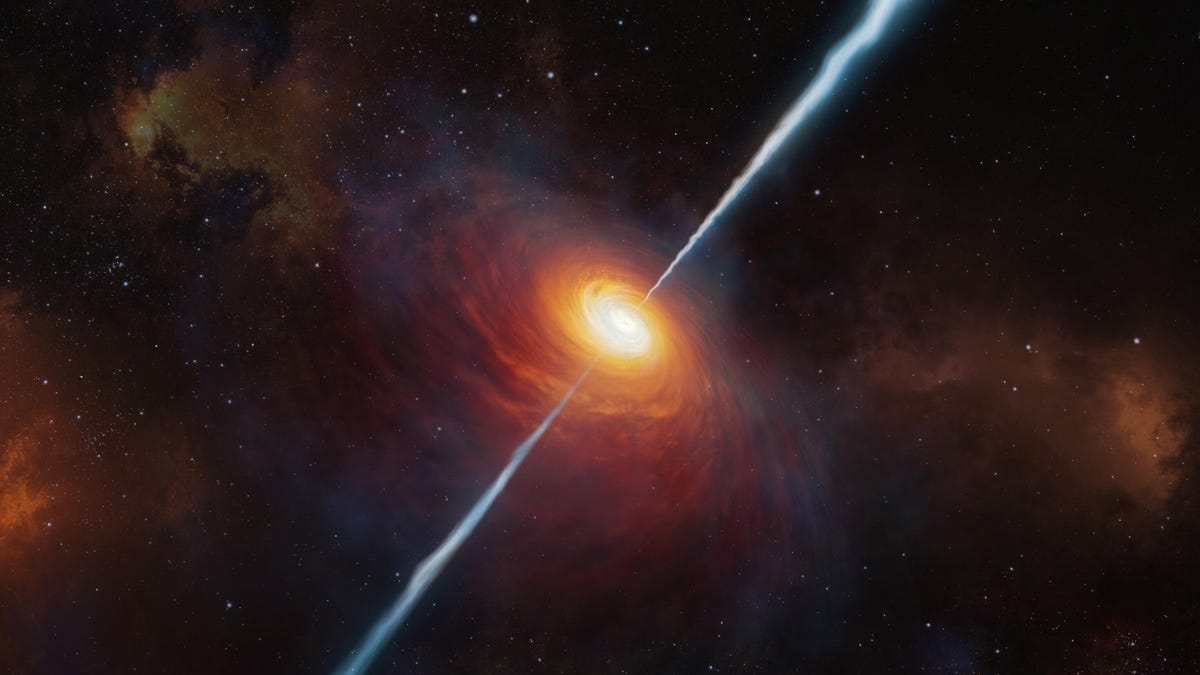
An artistic rendering of the quasar P172+18 associated with a black hole 300 times larger than the sun.
ESO/M. Kornmesser
Everything about this intricate image is fascinating. We have a black hole that Zakamska calls a “monster,” a very rare jet of light spitting out from that black hole, and a cluster of galaxies on a collision course — all seen as it is. billions of years ago.
So, dare I say it? JWST strikes again, presenting us with an extremely valuable cosmic vignette. The sign is jaw dropping.
Aucun commentaire
Enregistrer un commentaire