
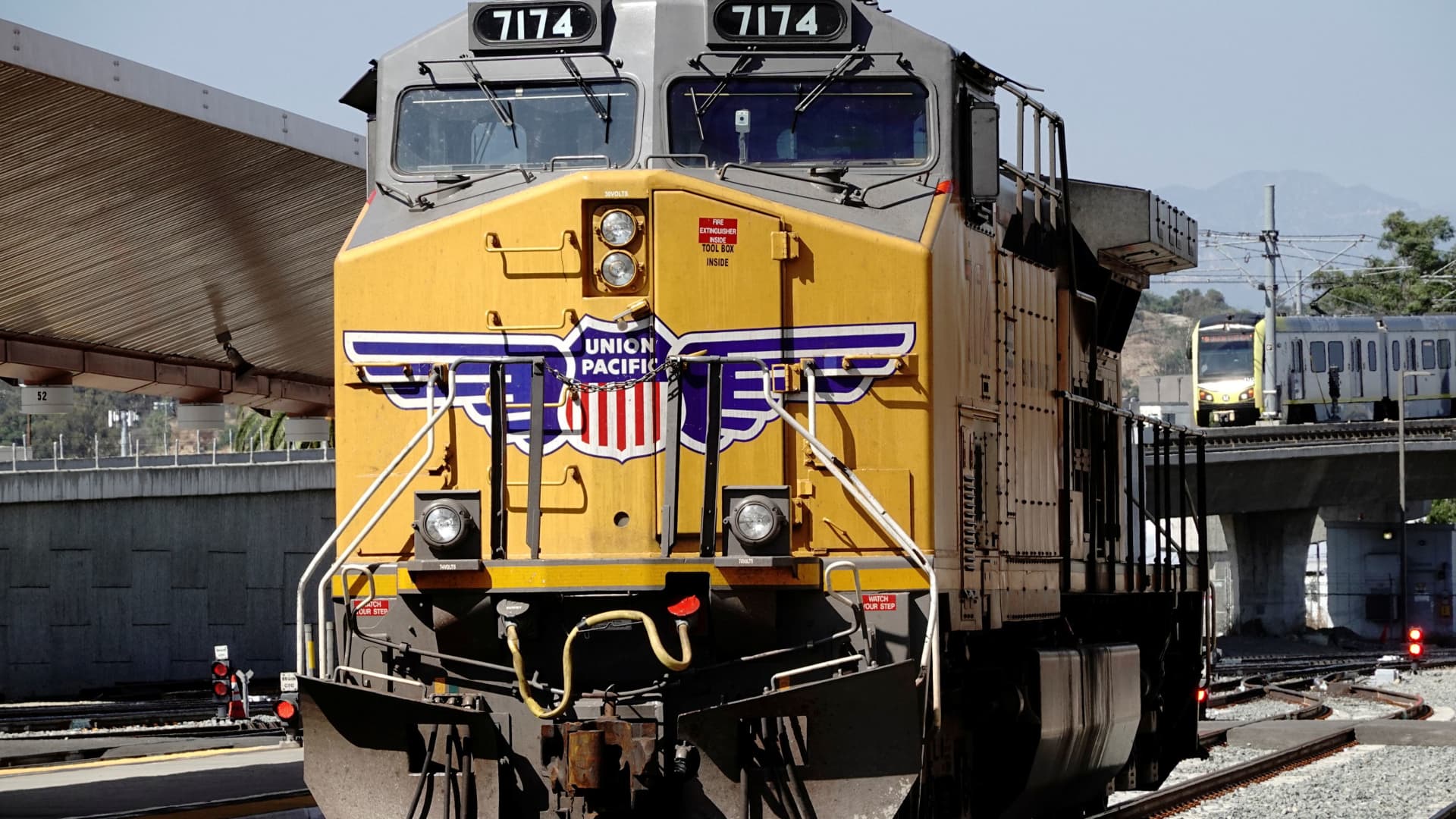
A Metrolink commuter train (right) arrives at Union Station in Los Angeles, California on September 15, while a Union Pacific view GE AC4400CW diesel-electric locomotive is seen before a possible strike in the absence of an agreement with the rail workers’ unions. , 2022.
Bing Guan | Reuters
The Brotherhood of Railroad Signalmen is the second union to reject the crucial interim agreement reached on September 15 between rail unions, freight rail companies and the Biden administration to avoid a nationwide rail strike.
Representing more than 10,000 railroad workers and one of the last three unions on the bargaining table, the BRS overwhelmingly rejected the deal, with 39.23% of members approving and 60.57% disapproving.
“For the first time I can remember, BRS members voted not to ratify a National Agreement, with the highest turnout in BRS history,” BRS president Michael Baldwin said in a statement. “I have expressed my disappointment throughout the process at the lack of good faith bargaining on behalf of the NCCC. [National Carriers Conference Committee]also PEB part [Presidential Advisory Board] 250 played in the denial of the right to paid leave for sickness to BRS members. Both NCCC and PEB failed to notice the safety-sensitive and highly stressful work that BRS members do every day to keep the rail running and the supply chain flowing.“
The rejection of the National Interim Agreement initiates a “status quo” period in which the union will re-engage with the NCCC by December 4.
“The parties have agreed to maintain the status quo so that discussions about next steps can move forward,” a spokesperson for the American Railroad Association told CNBC.
Half of all rail unions have approved deals, based on President Biden’s PEB recommendations, that include the biggest pay rises in nearly fifty years, leading to an average of more than $11,000 per rail worker in emergency payments before the holidays, the AAR spokesperson said.
A spokesperson for the railroad said, “Once in effect, the contracts, drawn up in partnership with the most labor-friendly management ever, will allow railroads and railroads to be successful in the future and deliver for both our customers and our families.” Said.
Railroads estimates that a rail strike could cost the economy $2 billion a day.

BRS’s vote against ratification came after the Roadworkers Care Fellowship (BMWED) voted not to ratify the interim agreement on 10 October. Logistics executives told CNBC they were rescheduling for a possible strike after the September deal seemed to reduce the workload. threatening.
In a letter to members on Wednesday, BMWED chairman Tony Cardwell said, “Before I can talk about the details surrounding the bargaining process, I have to confront some of the fringe groups who are proposing dangerous ideas such as unauthorized work stoppages. The bargaining brought different perspectives, complex conversations and difficult choices. One group member’s opinion The difference is a good thing, if a little messy. But we are not facing a situation so dire that we cannot use the means at our disposal. The collective power to get a satisfactory deal without breaking the law.”
Cardwell said the union will hold a series of video meetings for members on November 1-2.
The earliest date the BMWED union can strike is 19 November.
Union Pacific CEO Lance Fritz told CNBC during an interview on BMWED’s “Squawk on the Street” last Thursday: We’re doing this. I’m sure we’ll find a way to make a deal that can be withdrawn for approval. That doesn’t mean the strike isn’t possible, I just think it’s unlikely. We have a lot of tracks to figure this out.”
Union Pacific, Berkshire HathawayBNSF, CSX, Norfolk South and US railroads owned by canadian nationI am among the Class I freight railroads represented by the NCCC.
Union spokespersons stressed that railroads underestimated union members’ resistance on issues related to quality of life and benefits, including paid leave, which they felt the current interim agreement did not satisfactorily cover.
“The railroads consistently underestimate the frustration and anger of workers. The workers can’t stand it anymore,” BMWED adviser and chief collective bargaining spokesman Richard Edelman told CNBC last week. “The decision of the Presidential Emergency Board (IPB) is only a recommendation. This is not a cover. The carriers have demonstrated their determination not to do more than the net equivalent of the ISE.”
In his letter to members, Caldwell added: “While BMWED leadership, the public, and legislators have campaigned to inform rail companies about their reluctance to provide essential sick days, Carrier Executives have yielded to Wall Street’s desire to get more than their fair share. They take this stance. “As long as they are exhibiting, all we can do is encourage solidarity and prepare to help ourselves.”
BMWED is the third largest union with 23,900 members. All 12 unions, representing a total of 115,000 workers, must ratify their contracts to avoid a possible shutdown of the national freight rail system. Six rail unions voted to approve the deal.
Under the Railroad Work Act, Congress has the power to impose the resolution from Biden’s Presidential Emergency Board or order trains to operate as usual with the extension of negotiations.
.
Aucun commentaire
Enregistrer un commentaire