

As summer drew to a close and the United States entered fall and winter, doctors worried that Americans would see a “twindemia” in which both the flu and COVID-19 spread simultaneously.
But experts told ABC News the country may now be threatened by a “triple epidemic,” as doctors have seen an early rise in other pediatric respiratory viruses, particularly respiratory syncytial virus, or RSV.
According to the Centers for Disease Control and Prevention, respiratory diseases occur earlier and in more people than in recent years.
The federal health agency said there were early increases in flu activity across much of the United States, with indications that this season could be much more severe than the previous two seasons.
As of Monday afternoon, pediatric bed occupancy in the US is the highest in two years, with 75% of the estimated 40,000 beds filled with patients, according to ABC News analysis.
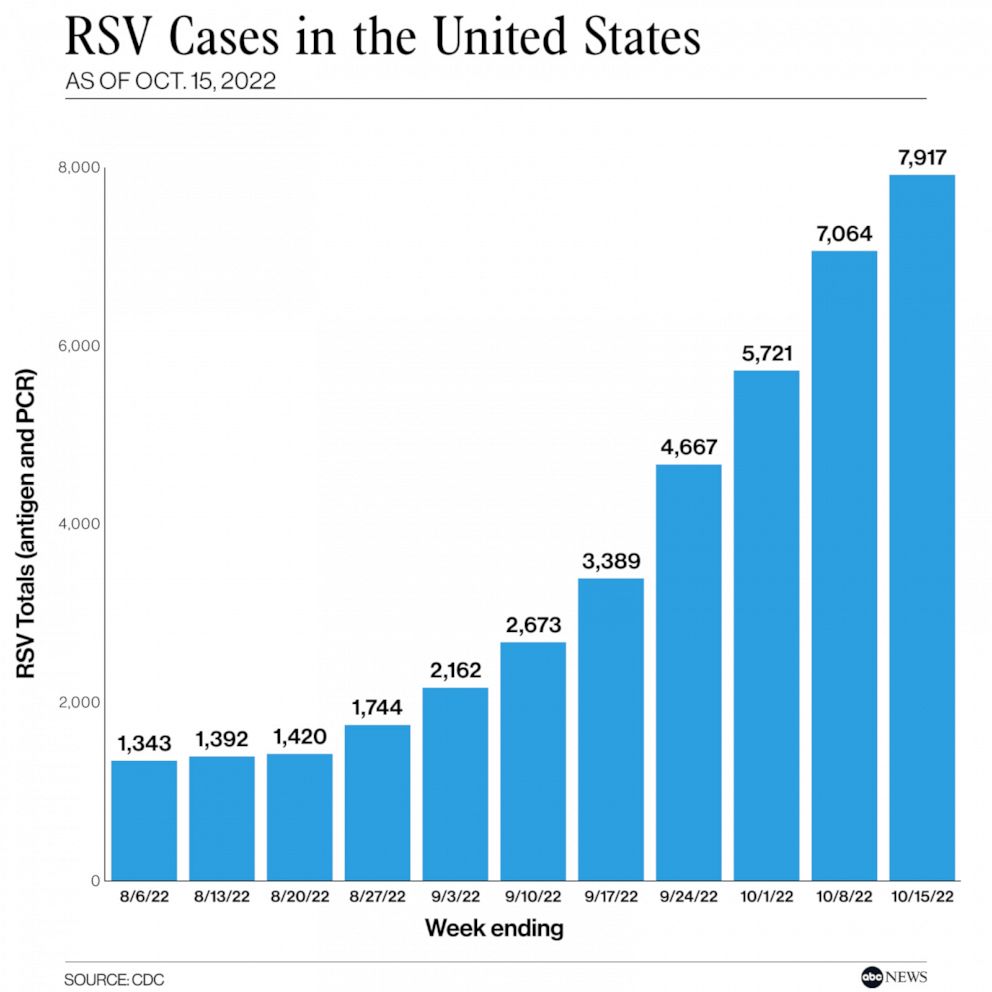
CDC data shows that COVID-19 infections have not yet begun to rise. But in previous years, the virus began to spread around Thanksgiving.
The combination of reduced immunity to COVID and lack of exposure to other viruses with close gatherings indoors is fueling a “perfect storm”, experts said.
Epidemiologist and chief innovation officer at Boston Children’s Hospital, Dr. “Often the problem is that the population immunity is low and the children are reunited once again, and this makes it easy for viruses like RSV to spread rapidly,” said John Brownstein. News contribution. “And because of the volume of infections, when the numerator is larger, you run into a situation where some of these children have to be treated in hospital. And so, our hospitals are spreading thin, not just for bed capacity, but also for the critical personnel of those beds.”
“So the combination of famine, bed capacity, and increased viral disease is causing an unfortunate perfect storm that we’re seeing ubiquitous right now.”
MORE | RSV in children: symptoms, treatment and what parents need to know
Revival of respiratory viruses
There have been more restrictions in the last two years such as masking, social distancing, capacity limitations and school closures. This meant fewer Americans were exposed to the flu and other viruses, including RSV.
Now, with little or no mitigation measures in cities and states across the country, these viruses are causing a re-emergence.
The medical director of Lurie Children’s Hospital in Chicago, Dr. “This leaves many children born since March 2020, especially young children, who have not yet encountered RSV infections,” Larry Kociolek told ABC News. “And so it will increase the virus’s ability to spread and increase the number of children that will be infected.”
According to the CDC, flu test positive rates rose from 1.27% in the week ending September 24 to 4.38% in the week ending October 15, which is higher than normal for this time of year.
SEE ALSO: Increasing cases of flu and growing concerns about when you should get vaccinated
Another challenging issue for hospitals is staffing shortages, Brownstein said.
“We already have an overworked and overly stressed workforce, with many leaving the healthcare industry due to burnout,” he said. “Moreover, there is infection among medical personnel.”
the importance of the vaccine
Doctors told ABC News that it is vital that children get vaccinated to prevent serious complications. Children can be hospitalized from any of these infections, and those with underlying conditions are at highest risk.
“If your child hasn’t had the flu shot yet, he should definitely be vaccinated. [gets one] D., medical director of pediatric infectious disease at Orlando Health Arnold Palmer Children’s Hospital. “As soon as possible,” Federico Laham told ABC News. “As we know, it takes a few weeks to respond. Particularly after these last two years when there was little flu circulation, some children whose immune systems have become a bit lazy and forgetful. So it’s important to ‘remind’.”
“The same goes for the COVID vaccine. Some children developed COVID early in the pandemic and weren’t vaccinated afterwards. We know it works, we know it’s extremely safe,” Laham said.
Also, experts say parents may consider wearing masks with their children and making sure they practice good hand hygiene and wash hands thoroughly with soap and water.
Associate professor of pediatrics Dr. “The other thing schools and kids can do is make sure you bring hand sanitizer with you to school so you can clean your hands and wipes to wipe down surfaces,” says Tom Murray. The division of infectious diseases at Yale University School of Medicine told ABC News. “And again, common points of contact, but wiping contaminated surfaces is especially important with viruses like RSV.”
ABC News’ Eric Strauss contributed to this report.
Copyright © 2022 ABC News Internet Ventures.
.
Aucun commentaire
Enregistrer un commentaire