
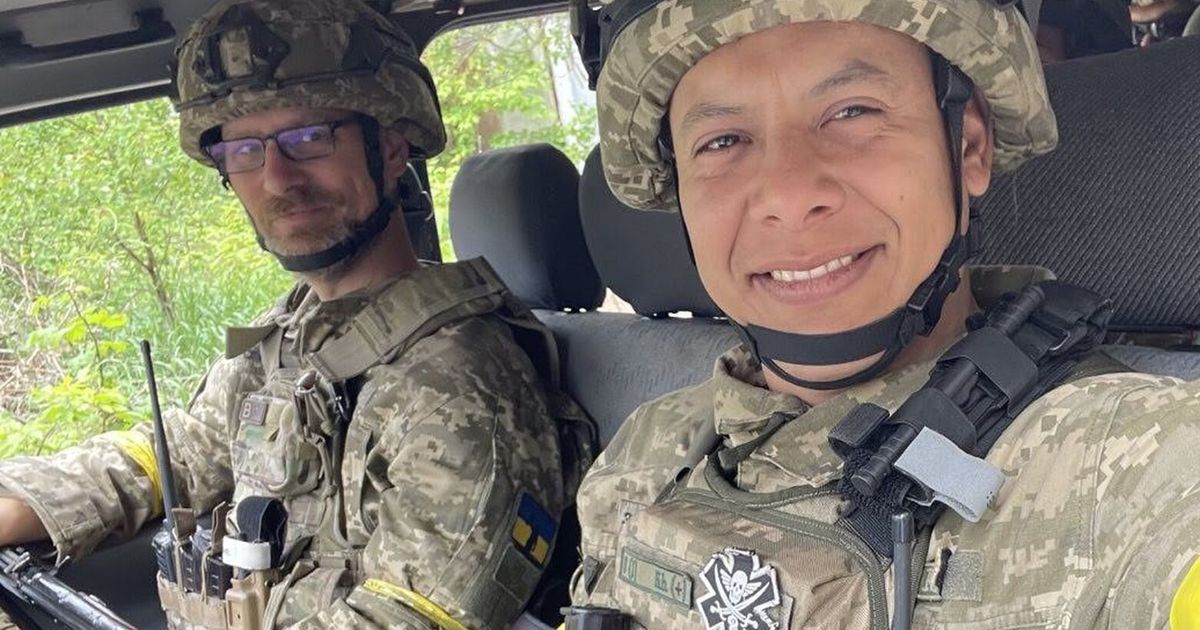
In March, Iraq War veteran Carl Larson took a leave of absence from his digital marketing job in the Puget Sound region to join the Ukrainian fight against the Russian invasion of their country.
He spent his toughest weeks in the frontline trenches of northeastern Ukraine.
Artillery fire kept him awake most nights, and it was easy to confuse stray dogs walking nearby with Russian soldiers spying on the position of the International Legion of the Ukraine Defense Corps.
The risks of coming out of the trenches on the afternoon of May 31st were brutally demonstrated. Larson and several other soldiers gathered at a command center in a nearby house. A Russian shell hit a tree, then shrapnel hit the head and groin of German legionnaire Bjorn Clavis.
The soldiers did not have a generator to charge their radios and also a vehicle. So they had to use a runner to call paramedics.
About 40 minutes later this help came. But Clavis died in the ambulance.
“He’s lost a lot of blood,” Larson said.
Larson believes Clavis could have been saved had the unit been able to charge its radios. And since returning to his home in Snohomish County in July, he has been raising money to buy generators and other supplies for the legion of soldiers who, in the middle of cold autumn, began to join the Ukraine’s fast-moving offensive from defensive positions in the trenches to reclaim the land. being held by the Russians.
On Thursdays, Larson meets with a legion of supporters in a banquet hall at European Foods, a grocery and restaurant in north Seattle. On plates of borscht and chops they share news about legions and what equipment is needed.
Larson said both Ukrainian and legion units are facing shortages, despite international aid from the U.S. government, which includes more than $18.2 billion in security aid since 2021.
The Legion’s current list of needs includes more cold weather equipment, drones, communications and vehicles. And some who served in the legion say their unit has more serious shortcomings compared to other frontline forces.
“We’re a great PR stunt because ‘Wow, look at all these foreign soldiers willing to put their lives on the line for Ukraine,'” said Stuart Burnside, a British veteran from Yorkshire who has been in Ukraine since February. “But we’re fed crumbs now – to be fair.”
Others say famine is a common challenge.
American Evelyn Aschenbrenner, who quit her teaching job in Poland and was assigned to the International Legion administrative job, said, “Unfortunately, the reality is that there isn’t enough material right now.”
Ukraine ‘much more stressful’
The Legion was created by the Ukrainian government to organize combat units made up of foreigners to fight in the war. The Russian government declared that they would be seen as mercenaries and would be deprived of their regular duty troops if caught. But that didn’t stop most of them from going to Ukraine, where they were educated and paid for their services, not only from North America, Great Britain, and Europe, but also from Latin America and the former Soviet Republic.
Larson, 48, enlisted in the US Army four months after 9/11 and worked as a combat engineer during the 2003 invasion of Iraq. Settling into middle age, he was inspired to take up arms again by what he saw as the moral imperative to prevent the slaughter of civilians and thwart Russian President Vladimir Putin’s goal of military conquest.
He said his experiences in Ukraine were “much more stressful and frustrating” than his service in Iraq.
Initially, Larson was horrified by some prospective recruits who had no military experience or seemed indecisive. And Larson initially gave up joining the International Legion, worried about where he might be sent, what he would be assigned to do, and with whom he might serve.
But after meeting with the Ukrainian authorities, he began to help screen newcomers to the legion and prepare them for service. He later joined a legion battalion and trained for five weeks, most as platoon leaders, before deploying to the front.
Larson said his unit was located in zig-zag trenches, some of which were initially attacked by German soldiers during World War II.
“We just got them out. They’re pretty well made,” Larson said.
In the hours before dawn, he sometimes had to tinker with chores at his home—looking for contractors to fix a house he and his wife had bought in Snohomish County.
Some of the legion soldiers Larson encountered had served for a few months and left, while others had been in Ukraine since late winter. Most get a codename that can be easily remembered and spoken on the radio. Larson was told he would become the Grinch.
Larson said that over the course of his service, the legion evolved, emerging as a more cohesive fighting force composed largely of a more professional mix of hundreds of military veterans. (Detailed legion troop numbers are not made public.)
Larson concluded that his military career in Ukraine was hit by a stalemate after clashes with a Ukrainian officer he claimed had stolen money from the unit. The officer was scolded, but remained in command, and Larson was given a new job digging trenches.
A legion spokesperson said it “cannot comment on individual claims and individual circumstances. However, “we have first-hand experience of surviving corruption and troubled people. It can and is done.”
Impatient for his wife’s return, Larson decided to fly to Washington a few weeks earlier than planned.
return to Washington
Returning to Washington, Larson remained in contact with some legions of soldiers as they advanced into towns once held by the Russians. Legion casualties climbed.
“We now have soldiers in combat, and they are more direct targets for tanks and grenades,” Aschenbrenner said.
The Legion has released what its communications spokesperson calls a partial list of eight legion deaths.
Burnside said more than a dozen people had died as of October 5. “It’s hard. We’re losing our friends,” he said.
Larson recently founded a nonprofit to help supply the legion. He says a chain of custody has been set up to combat those trying to take advantage and profit to provide provisions for legion soldiers.
He also raised money for the legion at events organized by the Ukrainian American community in the Puget Sound region.
Larson does not plan to return to duty with the Legion.
“My wife hid my passport,” he said. “I hope it didn’t burn.”
Aucun commentaire
Enregistrer un commentaire