
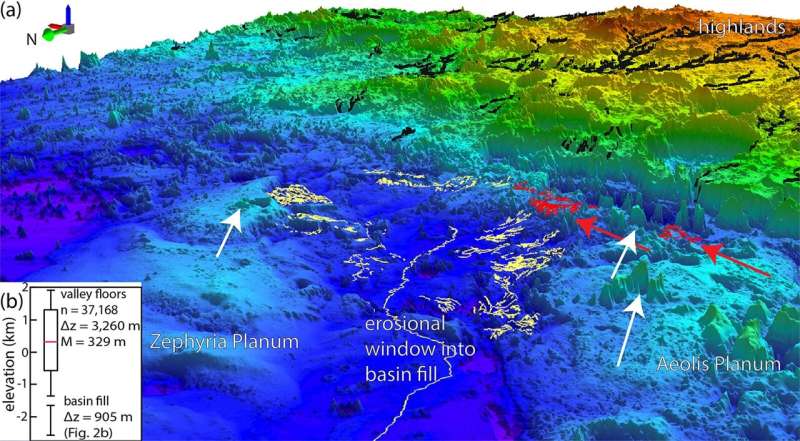
There has been a long debate in the scientific community about whether Mars has an ocean in its low-altitude northern hemisphere. Using topography data, a Penn State-led research team was able to show conclusive evidence of a roughly 3.5-billion-year-old coastline with significant sedimentary deposits at least 900 meters thick, covering hundreds of thousands of square miles. Credits: Benjamin Cardenas/Penn State
A series of recently released topography maps provide new evidence for an ancient northern ocean on Mars. The maps present the strongest case that the planet was once inhabited by sea level rise, consistent with a prolonged hot and rainy climate, not the harsh, frozen landscape that exists today.
“One of the key points that immediately comes to mind here is that the existence of an ocean of this size means a higher potential for life,” said Benjamin Cardenas, assistant professor of geosciences at Penn State and lead author of the recently published study. inside Journal of Geophysical Research: Planets.
“It also tells us about the ancient climate and its evolution. Based on these findings, we know that there must have been a period when it was hot enough and the atmosphere thick enough to carry this much liquid water at once.”
Cardenas explained that there has been a long debate in the scientific community about whether Mars has an ocean in its low-altitude northern hemisphere. Using topography data, the research team were able to show conclusive evidence of a roughly 3.5 billion-year-old coastline with significant sedimentary deposits at least 900 meters thick, covering hundreds of thousands of square kilometers.
“The big, new thing we did in this paper was to think of Mars in terms of its stratigraphy and sedimentary record,” Cardenas said. Said. “On Earth, we plot the history of waterways by looking at sediment that has accumulated over time. We call it stratigraphy, you can measure changes on Earth by understanding the idea that water carries sediment and the way that sediment is deposited. That’s what we did here – but this is Mars.”
The team used software developed by the United States Geological Survey to map data from the National Aeronautics and Space Administration (NASA) and the Mars Orbiter Laser Altimeter. They discovered more than 6,500 kilometers of fluvial ridges and grouped them into 20 systems to show that the ridges are likely eroded river deltas or submarine channel belts that are remnants of an ancient Martian coastline.
Elements of rock formations such as ridge thicknesses, elevations, locations, and possible sedimentary flow directions helped the team understand the evolution of the region’s paleogeography. Cardenas explained that the area that was once an ocean is now known as Aeolis Dorsa and contains the densest collection of stream ridges on the planet.
“The rocks in Aeolis Dorsa contain some fascinating information about what the ocean was like,” he said. “It was dynamic. Sea level rose significantly. Rocks were accumulating rapidly throughout their basins. There was a lot of change here.”
Cardenas explained that ancient sedimentary basins on Earth contain stratigraphic records of evolving climate and life. If scientists want to find a record of life on Mars, an ocean as large as the ocean that once covered Aeolis Dorsa would be the most logical place to start.
“An important goal for Mars Curiosity rover missions is to look for signs of life,” Cardenas said. Said. “It was always looking for water for traces of habitable life. This is the largest ever. A giant body of water from the highlands, possibly fed by nutrient-bearing sediments. If there were tides on ancient Mars, these would have been. I was here, gently carrying water in and out. This is right here.” It’s the kind of place where ancient Martian life might have evolved.”
Cardenas and colleagues mapped what they identified as other ancient waterways on Mars. An upcoming study in the Journal of Sedimentary Research shows that the various outcrops visited by the Curiosity rover are likely sedimentary layers from ancient river bars.
Another article published in the journal Nature Geology It applies an acoustic imaging technique used to image the stratigraphy below the seafloor of the Gulf of Mexico to a Mars-like model of basin erosion. The researchers determined that landforms commonly found across Mars, called fluvial ridges, are ancient river deposits eroded from large basins similar to Aeolis Dorsa.
“The stratigraphy we are interpreting here is quite similar to the stratigraphy on Earth,” Cardenas said. Said. “Yes, it sounds like a big claim to say we’ve discovered records of major waterways on Mars, but in reality, it’s relatively ordinary stratigraphy. It’s textbook geology once you get what it is. The interesting part is, of course, on Mars?”
More evidence of water on Mars
Benjamin T. Cardenas et al, Paleogeographic Reconstruction of an Ocean Edge on Mars Based on Delta Sedimentology in Aeolis Dorsa, Journal of Geophysical Research: Planets (2022). DOI: 10.1029/2022JE007390
Benjamin T. Cardenas et al. Martian landscapes of stream ridges carved from ancient sedimentary basin fill, Nature Geology (2022). DOI: 10.1038/s41561-022-01058-2
Provided by Pennsylvania State University
Quotation: Ancient ocean tracks discovered on Mars (2022, Oct. 27), retrieved Oct 28, 2022 https://phys.org/news/2022-10-ancient-ocean-mars.html
This document is subject to copyright. No part may be reproduced without written permission, except in any fair dealing for private study or research purposes. The content is provided for informational purposes only.
Aucun commentaire
Enregistrer un commentaire